The network for agriculture in Ontario, Canada
Son of a Beekeeper Blog on Ontario Agriculture Network
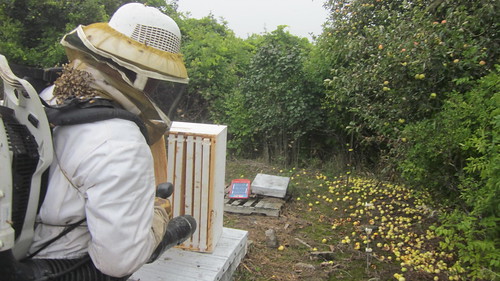 Hello from Rob Campbell the original Son of a Beekeeper in Ontario Canada.
I hope to keep a blog presence here on the Ontario Agricultural network to keep readers updated on the latest challenges facing Canadian beekeepers. Because I have the good fortune of living near and helping out my family's apiary which is just east of Toronto, the city in which I live and work
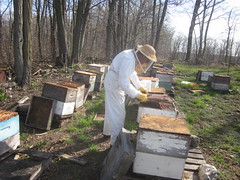
I write about The business of Beekeeping, Harvesting Honey in Ontario and most recently Feeding Antibiotics to Honeybees on Wondercafe blog.
People sometimes stop and ask me what is killing the bees? And I shrug and look away, for I have no concrete evidence that any one big new thing is killing bees beyond all the dozens of little things that are already know to be hurting honeybees. We know that certain viruses and fungi, and things like chalk brood hurts bees, and mites hurt, and American Foulbrood is devastating. That's why we feed antibiotics.
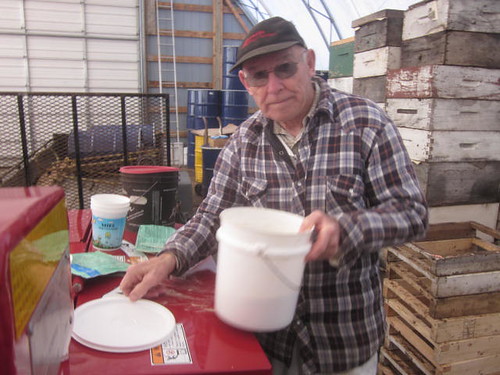 Here is a master beekeeper in Ontario mixing up Oxysol 62.5 antibiotic powder with white cane sugar before going to unpack his beehives from the winter cold storage boxes. This medication is applied first thing in the spring, four times each hive.
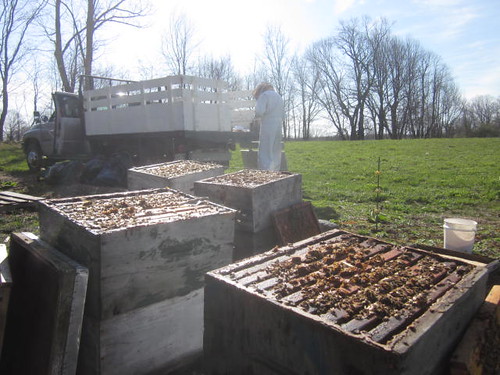
In this first visit, the beekeeper takes away the protective insulation around the wooden boxes, and reconnects the solar panels on the capacitor device for charging the two strand electric fence that surrounds the beeyard of 25 individual hives. Not all the colonies will have survived the Canadian winter and those 'dead' boxes wherein the bees probably froze to death will be scraped out and recycled.
If there is honey in the black frames of the brood chamber it will be soon be robbed out by stronger hives nearby. On his next visit, the beekeeper will split these strong hives into the empty equipment.

.
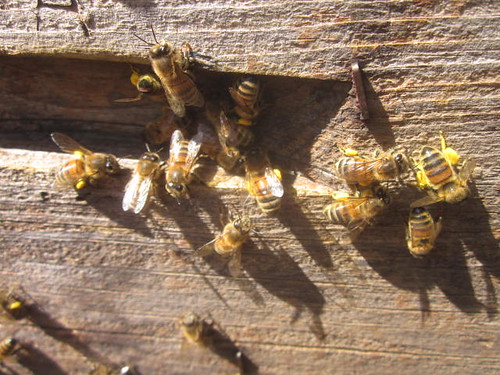
There are many threats to modern apiculture but today the worst seems to be American Foulbrood, followed by Veroa mites. One is a relatively quick death, while the other is blood suckingly slow. We feed antibiotics to honeybees three times in the spring. We mix Oxytetracycline HCI soluble powder with powdered sugar to help prevent American Foul Brood. * I will detail our precautions against mites in another post.
American foulbrood (AFB) is caused by the spore- forming Paenibacillus larvae ssp. larvae (formerly classified as Bacillus larvae), and is the most widespread and destructive of the bee brood diseases. Paenibacillus larvae is a rod-shaped bacterium, visible only under a high power microscope. Larvae up to 3 days old become infected by ingesting spores that are present in their food. Young larvae less than 24 hours old are most susceptible to infection. Spores germinate in the gut of the larva and the vegetative form of the bacteria begins to grow, taking its nourishment from the larva. Spores will not germinate in larvae over 3 days old. Infected larvae normally die after their cell is sealed. The vegetative form of the bacterium will die but not before it produces many millions of spores. Each dead larva may contain as many as 100 million spores. This disease only affects the bee larvae but is highly infectious and deadly to bee brood. Infected larvae darken and die.
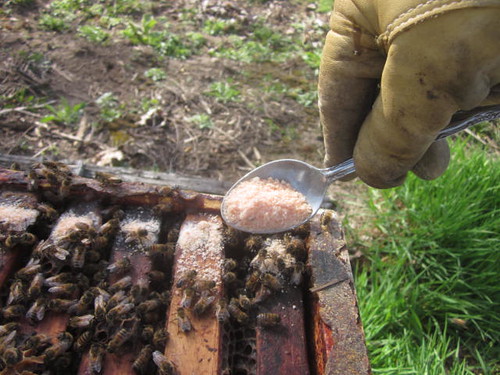 Oxysol 62.5 is used for inoculating honeybees against AFB American foulbood
Like many commercial beekeepers in Ontario, we adhere to a regular antibiotics program to keep our honeybees healthy, and our business more profitable.
The Trouble in Niagara Falls
Years ago myself and my father and uncle were part of a program to destroy infected beehives from fruit crop owners in Niagara Falls because the orchard owners and agricultural producers had unknowingly allowed their beehives, which exist almost exclusively for the purposes of pollinating fruit tree blossoms, to become infected with American foulbrood. We burnt hundreds of beehives in a gravel pit near Pinbrook Ontario. Please understand, destroying their hives was a 'final solution, and not something that should ever be repeated.
Today we apply Oxytetracycline HCI powder, mixed with sugar directly to the tops of the wooden frames inside the beehive. In an vacuum sealed food container, we mix 4 g of Oxysol powder into 35 g of white cane sugar (or 400 g (1 pouch) of powder to 3.5 kg (total of 3.9 kg)) together to apply, as you can see in the picture below, we dust the mixture directly onto the ends of the frames inside the open beehive at the rate of approx 32 g per colony, which is spread out over three visits to each hive. We begin the drug treatment as early as possible in the springtime for two reasons. 1) the strong hives are raiding and robbing out the dead hives, which may have died over the winter because they were diseased. 2) The antibiotics program must be completed at least four weeks before the honey flow begins in July, or we could risk contaminating the harvested honey product with antibiotics.
Commercial beekeeping relies the Agricultural Science programs of Canadian Universities, esp University of Guelph for the products they can apply to solve the problem of parasites and predators. In general, the same rules apply here as they do in every sector of industry. Business management consultants will always advocate to test different solutions to the same problem.
The cold Canadian winter is the ultimate acid test for a colony of honeybees.
Views: 1505
Comment
-
Comment by Joe Dales on April 22, 2012 at 1:03pm
-
Hi Rob,
Thanks for sharing your blog.
When I was young, my father had some bee colonies on our farm and I was amazed at how the bees behaved.
Take care,
Joe
© 2026 Created by Darren Marsland.
Powered by


You need to be a member of Ontario Agriculture to add comments!
Join Ontario Agriculture