Ontario Agriculture

The network for agriculture in Ontario, Canada

Women in Agriculture

Information

Women in Agriculture

A forum for women running and working on the farm

Members: 33
Latest Activity: Oct 23, 2014

Video: Challenges of City Girls Becoming Farm Wives.

Discussion Forum

Women and Farming - Strategic Iniative - School Project

Hello!I am in the Assaulted Women and Children’s Counsellor/Advocacy program at George Brown College. I am currently working on a project with a group that looks at the impacts of globalization and…Continue

Started by Anna Morgan Mar 28, 2012.

Women in farming: School project 4 Replies

Hi everyone! I am a third-year journalism student at Loyalist College. Currently, I am working on a documentary about women on the family farm.I want to explore how these days, women are taking on…Continue

Tags: agriculture, farming, women

Started by Katrina Geenevasen. Last reply by Katrina Geenevasen Nov 14, 2011.

heads up

headsup for those who stick with us through good and not so good times.

Started by rein minnema Nov 10, 2009.

Comment Wall

Comment

You need to be a member of Women in Agriculture to add comments!

Comment by Joann on December 18, 2013 at 5:42am
I read the comments concerning family names on barns especially the comments from Prof. Lonnie Aarssen.

Through personal research, I would like to supply a different dimension.

If one reads Agricultural Laws in roman times, you will be astonished at the similarities to today's customs on the farm in Ontario. One such law, 2000 years ago, was a farm shall be named by the former owner or the original owner. It was about property identification. Old English laws have their roots in old Roman laws. The first Act in Upper Canada dealt with property rights which found its roots in Roman Law.

Why were women omitted in farm property identification? Simple. Women for centuries were not considered "persons".

When it came to property rights, there were a few conditions to be considered a person but the main one was a "person" had to have a "soul". If one had a "soul" then you were considered a "person". If one did not have a "soul" you were not a "person" and could be considered as "property".

"Persons" could own "property". That is why corporations ( except the Sovereign and the Church) could not own land.


If you search for old land patents, you will notice the lands were granted in the men's names.

I have not followed the research through such as in the case if there were no male heirs, so I do not know what the actions were in those cases.

As society has evolved, old customs die hard in rural Rural areas. Our old way to quickly identify farm land has been replaced by civic addresses. There is little need to put a name on a barn today.
Comment by AgOntario on December 30, 2011 at 5:55am

Women need mentors for farm leadership roles


Farmers where I grew up, near Wallaceburg in southwestern Ontario, had at least one common trait. They proudly proclaimed their name and their male heir on the sides of their barns.

A half-century ago, I guess it was a sign of the times. For example, my uncle, who called his farm Ambitious Acres, had the barn painters stencil in “Don Cadotte and son,” the son being my cousin Greg.
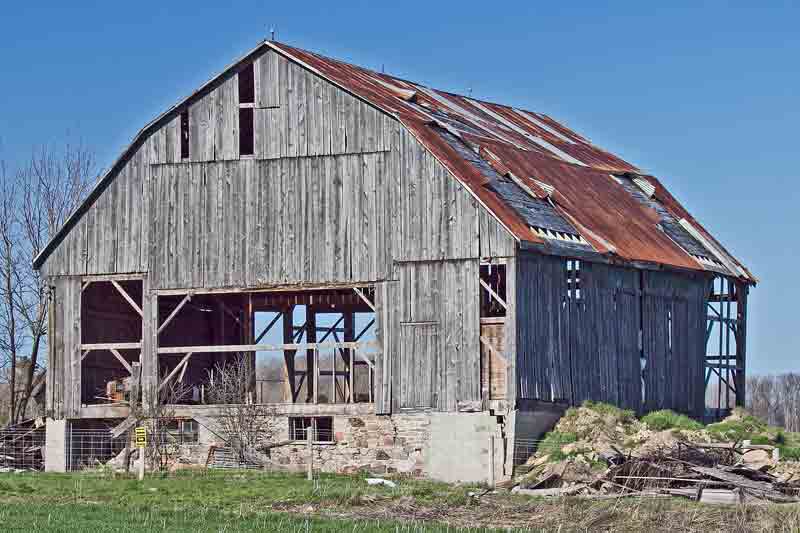
It's hard to read the name on the side of this barn, near Stouffville.

Indeed, Greg was his only son. But Uncle Don and his tireless wife Marie also had five very capable daughters, namely my other cousins Donna, Angela, Connie, Cathy and Michelle.

When it came to the barn, what about them?

Well, it turns out someone else from Wallaceburg, one of my oldest friends, Prof. Lonnie Aarssen, has come up with at least a partial answer. Aarssen, a biologist at Queen’s University, says my uncle and others like him were given to show off what Austin Powers would call his Mini Me – that is, a biological copy of himself.

“We’re aware of our mortality,” says Aarssen, “and having copies of ourselves is a mortality buffer.”

Aarssen and his research team asked almost 2,400 Queen’s students what gender of baby they would prefer first. Traditionally, in southwestern Ontario culture, boys were mentioned first. In the farm sense, they were not only heirs, but also as built-in farm labourers and schoolyard watchdogs for little sisters to come.

Aarssen anticipated traditional boy-first patterns. And he did, to an extent – 65 per cent of boys in the study said they want a boy first.

But the surprise came when more half of the women respondents said they wanted a girl, not a boy — a female version of Mini Me.

I’d love to see this survey applied specifically to modern farms. It’s still important that labourers be hale and hearty, but as mechanization continues to advance, a strong back isn’t all that counts anymore. That’s especially true when it comes to farm management, such as choosing crop protection, borrowing money and hiring labour, which is becoming increasingly fine tuned. It’s not a male domain.

Women say they need mentors to assume leadership positions in agriculture. I write about this in my Urban Cowboy column this week in the Guelph Mercury.


This entry was posted in Guelph Mercury and tagged farmers, Guelph Mercury, Urban Cowboy, women. Bookmark the permalink.
Comment by Kaitlin Schuster on December 21, 2011 at 7:19am

Hi everyone, I would like to introduce myself as Kait Schuster.  I currently work for Canada's Fruit & Veg Tech X-Change (www.frutveg.ca).  We are Canada's largest outdoor horticulture trade show, which will be this coming July 12, 13, 14  2012. 

This year we are incorporating a greatly overlooked category, women in agriculture.  We are adding a, "Farm Females XPO" portion to our event.  We are currently still in the planning process of what this XPO will all include although it will be geared towards what woman want and need within this industry, as well as other related interests.  I am eager to hear thoughts, comments, opinions, etc from women directly involved in agriculture.  If you have any ideas, suggestions or comments, etc please feel free to post on here or contact me directly at info@fruitveg.ca. 

Thanking you in advance!

Kait Schuster

Comment by Sandra Dales on November 29, 2011 at 3:24am

Farm Credit Canada looks to celebrate exceptional women in agriculture

Regina, Saskatchewan, November 22, 2011 – Nominations for the 2012 FCC Rosemary Davis Award officially open today, as Farm Credit Canada (FCC) seeks to recognize and honour Canadian women for their leadership and commitment to agriculture.

Agriculture matters and women positively impact the industry and their communities. FCC is looking for five women who deserve recognition for their achievements. Past nominees range from producers and educators to agrologists and veterinarians.

“More and more women play a leading role in the agriculture and agri-food industry,” says Kellie Garrett, Senior Vice-President, Strategy, Knowledge and Reputation at FCC. “Their leadership makes a significant difference to agriculture and their local communities. This award gives FCC the opportunity to recognize these exceptional women.”

Individuals are encouraged to take time to recognize a woman that they see making a difference in the agriculture industry. Self-nominations are also encouraged. Candidates are selected based on their demonstration of leadership – through giving back to their community and the agriculture industry – as well as their vision and passion for the industry. Since 2006, FCC has honoured 25 outstanding women with the Rosemary Davis Award.

Created and named after a successful Canadian agribusiness owner and operator – and the first female chair of the FCC Board of Directors, the FCC Rosemary Davis Award is testament to the growing number of women who are choosing to make a career in agriculture. 

Winners will be announced in March 2012. They will have the opportunity to attend the Simmons School of Management Leadership Conference in Boston on April 5, 2012 (http://www.simmons.edu/leadership).

“Coming together at this conference is a unique opportunity for winners of the award,” says Garrett. “They will have a chance to network and share knowledge. They’ll also hear from some of the world’s most accomplished women who have made their organizations – and the world – a better place to work and live.”

Last year’s winners included:
• Bertha Campbell – nurse, farm co-owner and community volunteer – Kensington, Prince Edward Island
• Wynne Chisholm – cow-calf producer, management consultant, volunteer – Calgary, Alberta
• Liliane Colpron – businesswoman, agri-food industry leader, visionary – Montreal, Quebec
• Rossana Di Zio Magnotta – philanthropist, educator and entrepreneur – Vaughan, Ontario
• Sherri Grant – producer, educator, volunteer – Val Marie, Saskatchewan

FCC Rosemary Davis winners must be 21 years of age or older, and actively involved in Canadian agriculture. Entries will only be received online atwww.fccrosemarydavisaward.ca. The deadline to apply is 11:59 p.m. (Central Standard Time) on January 22, 2012. Nominees who applied but did not win in previous years are encouraged to reapply. For more information, call 1-888-332-3301 or email prixrosemaryaward@fcc-fac.ca.

As Canada’s leading agriculture lender, FCC is advancing the business of agriculture. With a healthy portfolio of more than $21 billion and 18 consecutive years of portfolio growth, FCC is strong and stable – committed to serving the industry through all cycles. FCC provides financing, insurance, software, learning programs and other business services to producers, agribusinesses and agri-food operations. FCC employees are passionate about agriculture and committed to the success of customers and the industry. For more information, visit www.fcc.ca.

-30-

For more information, photos or to schedule an interview, please contact:

Anaïk Bernèche (bilingual)
Corporate Communication
Farm Credit Canada
306-780-3351
anaik.berneche@fcc-fac.ca 


Comment by Sara Avoledo on May 2, 2011 at 8:52am

Hi Ladies,


I have been running an informal group called Professional Women in Agriculture - Guelph chapter (PWAG) for awhile now...if anyone is interested in meeting up with us please let me know.  We do networking lunches, sometimes dinners and a few events here and there depending on how busy we all are.


Thanks,

Sara

Comment by Sandra Dales on January 26, 2011 at 8:36am
This is interesting ..click on this link to view a CBC archieve piece from 13 years ago... More women heading up the family farm
Comment by Kim Leatherdale on January 7, 2011 at 12:42pm

Hi Ladies,

I joined in December but whew that was a busy month so now wanted to touch base and find out a bit more about this forum. I am looking to connect with other women, share idea and passion and a bit of stress as I build a on-farm store business while at the same time learning the ropes of mixed farming. My husband and I bought the farm 4 years ago and currently are raising cattle, sheep and chickens for meat sales in our little store off the back of our house.

Comment by Sandra Dales on November 24, 2010 at 7:36am
Farm Credit Canada looks to celebrate exceptional women in agriculture
November 23: Nominations for the 2011 FCC Rosemary Davis Award officially open today, as Farm Credit Canada (FCC) seeks to recognize and honour women from coast to coast for their leadership and commitment to agriculture.

Women involved in agriculture positively impact the industry and their communities. FCC is looking for five women who deserve recognition for their achievements. Past nominees have ranged from producers and educators to agrologists and veterinarians, to name a few.


Since 2006, FCC has honoured 20 outstanding women with the Rosemary Davis Award. Individuals are encouraged to take the time to recognize a woman they see making a difference in the agriculture industry. Self-nominations are also encouraged.


"The agriculture and agri-food industry in Canada has benefited from the valuable contributions of women", says Kellie Garrett, Senior Vice-President, Strategy, Knowledge and Reputation at FCC. "This award allows FCC to honour remarkable women who make a difference to their communities and to the industry at large."


Candidates are selected based on their demonstration of leadership - through giving back to their community and the agriculture industry - as well as their vision and passion for the industry.


Created and named after a successful Canadian agribusiness owner and operator - and the first female chair of the FCC Board of Directors - the FCC Rosemary Davis Award is testament to the growing number of women who are choosing to make a career in agriculture.


Winners will be announced in spring 2011 and will have the opportunity to attend the Simmons School of Management Leadership Conference in Boston on April 26, 2011. For more information about the conference, visit http://www.simmons.edu/leadership/.
Comment by AgOntario on October 14, 2010 at 7:20am
On Wednesday, October 13, 2010, 85 people including men and women attended the first Women in Agri-Business Symposium in Guelph. There were representatives from numerous agriculture organizations including Ontario Pork. Speakers urged women to get involved and that they can make a difference.

The Canadian Consulate in Minneapolis has been instrumental in arranging for several women from Canada to participate in the American Agri-Women (AAW) Convention in November 2007, 2008 and 2009 as members of panel discussions on agricultural issues and trade. American Agri-Women officially began in November 1974 founded by four state women’s agriculture groups which had previously organized.

Today, AAW has 50 state and commodity affiliate organizations as well as individual members throughout the country, representing tens of thousands of women involved in agricultural businesses.

Following the 2008 AAW Convention, the concept of organizing a similar organization or annual meeting in Canada began to form. Subsequently, four Ontario women were invited to participate in Syngenta Crop Protection’s “Leadership at Its Best” program as members of the AAW contingent. They were:
- Brenda Lammens – asparagus grower, Chair of the Ontario Asparagus Growers’ Marketing Board, and former Chair of Ontario Fruit and Vegetable Growers Assoc.
- Denise Zaborowski – Manager, Domestic Marketing Unit, Ontario Ministry of Agriculture, Food and Rural Affairs
- Angela Stiles – former Executive Director, Agricultural Adaptation Council
- Susan Fitzgerald – operates Fitzgerald & Co., which manages agricultural associations and provides project management services.

Rather than focusing on a women’s group to deal with agricultural issues, we determined that the best way forward was to focus on an initiative to encourage/foster women in agri-business leadership roles. The symposium targeted Canadian women involved in agricultural businesses from farm through to retail and in agricultural leadership roles either within an association/company/agency or on Boards and Committees.
Comment by Sandra Dales on September 16, 2010 at 10:34am
This sounds like a great event. I was just speaking to Marcie Williams, Past President/Finance Chair of the American Agri-Women. Marcie and Chris Wilson, President, will be coming up to speak at the conference.
http://www.americanagriwomen.org/
 

Members (32)


Agriculture Headlines from Farms.com Canada East News - click on title for full story

Hursh: My canola acreage prediction

Statistics Canada will release a seeded area estimate on June 30. This will be based on data collected in late May and early June. I'm predicting a larger than expected increase in canola acreage. In its preliminary seeding intentions report back in March, Statistics Canada predicted a 1.0 per cent increase in Canadian canola area to 21.8 million acres. A lot has happened since then and canola prices have seen more strength than other commodities. Canola also looks good from a crop insurance coverage point of view even in non-traditional canola growing regions. Canola is already a large percentage of the cropland in central and northern areas of the grain belt limiting how much more it can increase. However, I believe acreage may have increased dramatically in many southern regions. In southwest Saskatchewan where I farm, I can’t remember seeing so many canola fields. Canola here still isn’t nearly as common as lentils or durum, but there’s a surprising amount of canola and mos

Seeding virtually done in Saskatchewan, though some acres unseeded

The latest provincial crop report indicates seeding is basically done in Saskatchewan as progress is marked at 99 per cent complete. A map of seeding progress province-wide shows an area from Hudson Bay down to Yorkton is between 85 and 95 per cent complete, with pockets at less than 80 per cent complete. The east-central region as a whole is at 96 per cent complete while other regions are at 99 or 100 per cent. However, three per cent of acres of the province went unseeded due to excessive moisture. "Similarly, three per cent of forage crops have excess moisture and are unlikely to produce a crop while two per cent of pastureland is not accessible or is unusable," states the report. "In areas experiencing reduced moisture, two per cent of the seeded acreage this spring in the province is affected. Five per cent of the forage crops may have yields significantly impacted, while five per cent of pastures may have reduced carrying capacity." Rainfall this past week delayed fieldwork,

Cereals Canada Releases its 2025 Annual Report

Cereals Canada has released its 2025 Annual Report, highlighting a year of strong market development, technical leadership, and advocacy efforts that reinforced Canada’s position as a leading global supplier of high-quality wheat, durum, oats, and barley. Throughout 2025, Cereals Canada continued to support international customers and strengthen demand for Canadian cereals through targeted market development programming, technical expertise, and proactive market access engagement. Canada exported cereals to more than 80 countries, with cereal exports valued at approximately $12.8 billion annually, demonstrating continued global confidence in Canadian quality and reliability. A key priority throughout the year remained helping global customers understand and optimize the value of Canadian cereals. Through technical support, customer outreach, and crop quality programming, Cereals Canada worked closely with global buyers to ensure Canadian quality translated into measurable value throu

Cereals Canada Announces New Board Leadership

Adam Dyck, industry representative from Warburtons, has been elected Chair of the Cereals Canada Board of Directors. As Chair, Dyck will help lead the organization’s work to strengthen Canada’s position as a trusted supplier of high-quality wheat, durum, barley, and oats. Rounding out the executive committee is Josh Boersen, producer representative from Grain Farmers of Ontario, as Vice-Chair; Rob Stone, producer representative from Saskatchewan Wheat Development Commission, as Secretary; and Jean-Marc Ruest, industry representative from Richardson International, as Treasurer. The Board also welcomed four newly elected directors, whose insight and leadership will guide the organization’s efforts to support market development, customer engagement, and innovation across the cereals sector. “The Board of Directors plays a critical role in guiding our work on behalf of Canada’s cereals value chain,” said Dean Dias, chief executive officer of Cereals Canada. “We are pleased to welcome Ad

Knowledge Centre receives $2.6 million from Weston Family Prairie Grasslands Initiative

Stretching across Saskatchewan, Alberta, and Manitoba, Canada’s prairie grasslands support hundreds of species, including migratory birds, pollinators and people, while also sustaining soil health, water systems, livestock production, and Indigenous stewardship. Yet of the roughly 141 million acres of historical grasslands in Canada, only 26 million acres remain intact today. What remains of prairie grasslands represents a rare and urgent opportunity to protect biodiversity at scale. “Indigenous lifeways, languages, and food systems evolved with the environment, and these reciprocal relationships shaped the ecological processes that can restore the health of grasslands,” said Candice Pete-Cardoso, director of the kihci-okawimaw askiy Knowledge Centre at USask. The new Indigenous Grasslands Stewardship and Knowledge Exchange Network has been launched by the kihci-okawimaw askiy Knowledge Centre together with the Indigenous Kinship Circle (IKC). The IKC is a cross-boundary community of

© 2026   Created by Darren Marsland.   Powered by

Badges  |  Report an Issue  |  Terms of Service