The network for agriculture in Ontario, Canada
Will Kathleen Wynne be a good minister of agriculture?
I thought this was a good idea when I first heard it.
But judging by the negative comments and stories I am not too sure.
What does everyone else think? Will she have time to be Premier of Ontario and also do the job as Minister of Agriculture justice?
Views: 1136
Replies to This Discussion
-
Permalink Reply by Joann on
-
Will Ms. Wynne be a good minister of Agriculture? It would depend on her agenda to whom.
Will she protect and serve farmers that have Sovereign duties and obligations to the domestic public or will she bow to freer global trade by dissolving our present systems, throwing domestic obligations out the window?
It would appear (if my information is correct) Mr. McGuinty signed an agreement with Mr. Harper late June of 2008. From what we understand, a portion of the agreement affects agricultural marketing in Ontario. As Ms. Wynne was a cabinet member, I would find to hard to believe she would not know about the agreement.
Did Mr. Harper buy the very 'soul' of domestic marketing in Canada?
We have been told that the agreement does not exist only to be told by a 'friend' in CRA that the document does indeed exist but is "privileged" information and therefore cannot have access to it.
How much does Ms.Wynne know about agriculture and who will she serve?
-
Permalink Reply by OntAG Admin on
-
Media Release from Ag Critic Ernie Hardeman
Farmers Concerned about Part-Time Minister
“Wynne needs to realize that if agriculture is to survive in Ontario it does indeed need a full time Agricultural minister and one that is definitely in tune with where agriculture is and how important it is to the province.”
Eastern Ontario Farmer
WOODSTOCK – Today Ernie Hardeman, Oxford MPP and PC Critic for Agriculture, Food and Rural Affairs, said that he has heard from farmers from all across Ontario this week that are concerned about Premier Wynne's decision to be a part-time Minister of Agriculture.
“We have hundreds of different commodities here in Ontario, understanding their issues as well as the food processing industry requires a lot of time,” said Hardeman. “I’ve heard from farmers in Niagara, the Greater Toronto Area, Southwestern, Northern and Eastern Ontario who all expressed concern that the job of Agriculture Minister could not be performed part-time.”
Hardeman received the emails and calls from farmers following his February 11 open letter to Premier Wynne expressing reservations about her decision to serve as both Premier and Agriculture Minister and requesting a meeting to discuss agriculture issue. To date there has been no reply.
“Given the challenges the Premier needs to address, such as the $14 billion deficit, she will not have sufficient time to focus on the agriculture industry,” said Hardeman. “From my time as Minister of Agriculture I know that you need time to travel across the province to talk to farmers and meet with the different organizations to ensure you understand their concerns.”
A professional Agrologist wrote in his email: “I know from my experience working with Mr. William Stewart, Mr. Jack Riddle, Mr. David Ramsey, Mr. Elmer Buchanan and other agriculture ministers, that this responsible position requires full-time representation and long hours of work 7 days per week.”
The emails that Hardeman received were from farmers in a number of different commodities including: beef, pork, dairy, chickens, sheep, apples, plums, grapes, asparagus, onions, potatoes, sugarbeets, corn, soybeans, canola, ginseng, strawberries, maple syrup and flowers.
“The common theme in the messages is that Agriculture Minister requires a full-time commitment,” said Hardeman. “Some farmers were quite upset that they felt her decision to be a part-time Minister showed she didn’t understand or value the industry.”
-
-
The fact that we have been given a part-time and totally urbanized Agriculture Minister merely continues to reinforce the disdain that the Liberals perennially hold for our rural ridings.
This "appointment" is clearly nothing more than a misguided attempt to ingratiate a disenfranchised segment of the electorate to a pestilent party with poisoned policies.
We have some good herbicides for the undesirable growth in our fields, but we have yet to discover the treatment for the sickening condescension and mistreatment that streams down from the big smoke into the countryside.
-
Permalink Reply by Roadrunner on
-
I don't disagree with you John.
But isn't it better to have her at least briefed and spending some time on agriculture?
I am hoping that she does some good for farmers and the food industry, it is important to Ontario, it is just that Toronto people don't care or know where their food comes from.
Joann,
I would hope that Wynne will do what is best for Ontario and not have a predetermined agenda.
-
-
That is my hope also Roadrunner..... but.... Ms. Wynne declared from the onset that she would be 'Minister of Agriculture' along with her duties as Premier.
When sworn in, she swore to uphold her duties as 'Minister of Agriculture'.
4 days later, she saw fit to conduct a secret ceremony to uphold her duties as Minister of Agriculture and Food.
I thought it was wonderful that she at first declared to minister of "Agriculture" as the true meaning of agriculture concerns a "class of people (the farmer) working with natural resources (food). Adding the word "food" actually takes away from domestic natural production (food).... and the word is also redundant. Its like when she responded to the question about a heifer. She defined a heifer as a young female cow. I thought all cows were female.......redundancy for the sake of the urban mentality?
Where is she getting her advice concerning agriculture? If it is from the previous Premier's circle.... then we still have a HUGE problem.
-
-
Today's Twitter Post by @Kathleen_Wynne a Positive Sign
Agriculture will be a priority across our gov. We’ll soon be putting fwd a new local food act—good for our farmers, our economy, our health.
 Kathleen Wynne
 @Kathleen_WynneOur government will work collaboratively with Ontario’s municipalities. We’ll continue to improve roads and infrastructure.
Kathleen Wynne @Kathleen_WynneJoined
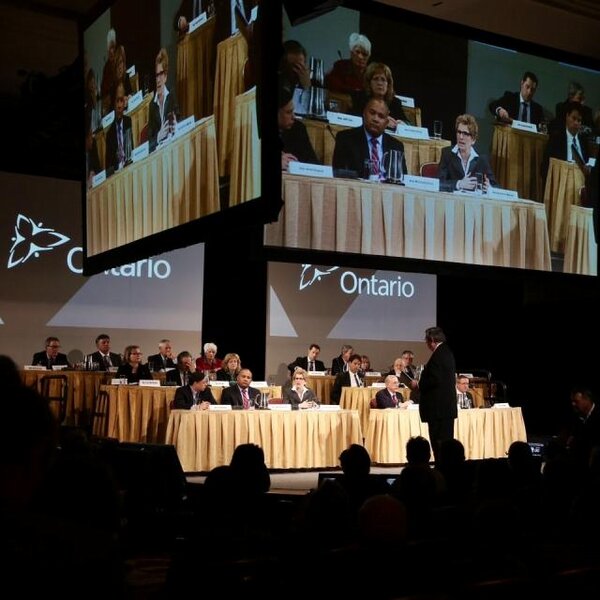
#ROMAOGRA conf. delegates this afternoon, and 20 other ministers, to share rural & agricultural perspectives:pic.twitter.com/YjJzXq93w0
-
-
Sorry.... been to Roma many times..... I've heard the talk about rural and local food issues.
Its just idle chatter at this point.................again.
This government needs to show a shred of respect to agriculture (farmers and the land).....enough of the talk.....now walk the walk.
I've asked 2 former ag. ministers a few questions and have not been answered to date. Maybe our new minister can enlighten us?
1. How many Sovereign marketing licenses exist in Ontario?
2.What is the value of those licenses?
3.If all marketing licenses are dissolved and all those farmers experience a one-time capital loss, how will it affect the Province?
Two more for our new minister as she was in cabinet:
4. Explain to us why 'agriculture' in Ontario is a Public Trust? (Hint; ask Mr. Dave Hope)
5.Did Premier McGuinty sell the very soul of Ontario's agricultural marketing rights to Mr. Harper in June 2008?
I look forward to meeting Ms. Wynne some time... maybe she will have some answers.... hopefully right answers.
-
-
"Swedes Debate Meat Tax Proposal - Western meat consumption must decrease, says Swedish Board of Agriculture"
http://www.theepochtimes.com/n2/world/swedes-debate-meat-tax-propos...
"Rules, taxes, and subsidies can push things in the right direction. But it's imperative that these are at an international level, otherwise there is a risk production will simply be moved where the regulations and tax burden is lightest, not where production is sustainable," Gabriella Cahlin, the board's head of marketing, said in a statement." ( http://www.thelocal.se/45746/20130122/#.US0BWTdVySo )
How many livestock producers, do you suppose, sit on the "Swedish Board of Agriculture"? See where it leads? We already know that Wynne was in full support of forcing municipalities to accept wind turbines, through the imposition of "rules and subsidies".
Gotta cut those CO2 emissions, you see? Fight that Global Warming! (They don't seem to be aware of the increasing data that indicates that rising CO2 is a result of climate change, rather than the cause. Nor do they want to be aware of it.)
“We need to get some broad based support, to capture the public’s imagination… So we have to offer up scary scenarios, make simplified, dramatic statements and make little mention of any doubts… Each of us has to decide what the right balance is between being effective and being honest.”
- Prof. Stephen Schneider,
Stanford Professor of Climatology,
lead author of many IPCC reportsWynne was there when the gas plant was cancelled and she was there when the GEA was imposed on rural Ontario.
"Agriculture will be a priority across our gov." - with the Liberal track record in mind, that should scare the heck out of farmers.
"Our government will work collaboratively with Ontario’s municipalities" - just like they did when they stripped the municipalities of any authority when giving wind turbine companies the right to plant their industrial turbines anywhere they wanted.
"...to share rural & agricultural perspectives..." Really? Friendlies only who will kiss the ring, as usual? Or did she hear the perspectives of those who are tired of having misguided and unaffordable Liberal ideology forced on them?
Color me bitter, but when a government has spent 10 years forcing an agenda that our grandchildren will not be able to pay off, I call a spade a spade.
-
-
Sad to say.. but you may very well have expressed the sentiments of more farmers than I care to admit.
I believe the pattern has been set already with Ms. Wynne.
When she was sworn in as Minister of Agriculture she said she would wear 2 hats.... Agriculture and Premier of Ontario.
Yesterday, as an example, she was in London promoting jobs. The media said the Premier of Ontario was in London.... no mention that she was also the Minister of the largest economic sector of Ontario....Agriculture. She must have left that hat at home.
No.... Ms Wynne is commonly referred as only the Premier with little to no mention of agriculture.
It is obvious Agriculture has no representation right now as the Premier only wears the Agriculture hat during sporadic coffee breaks at best.
It is totally shameful and dishonourable that the largest economic sector has only leadership of 'convenience'.
John Schwartzentruber said:"Swedes Debate Meat Tax Proposal - Western meat consumption must decrease, says Swedish Board of Agriculture"
http://www.theepochtimes.com/n2/world/swedes-debate-meat-tax-propos...
"Rules, taxes, and subsidies can push things in the right direction. But it's imperative that these are at an international level, otherwise there is a risk production will simply be moved where the regulations and tax burden is lightest, not where production is sustainable," Gabriella Cahlin, the board's head of marketing, said in a statement." ( http://www.thelocal.se/45746/20130122/#.US0BWTdVySo )
How many livestock producers, do you suppose, sit on the "Swedish Board of Agriculture"? See where it leads? We already know that Wynne was in full support of forcing municipalities to accept wind turbines, through the imposition of "rules and subsidies".
Gotta cut those CO2 emissions, you see? Fight that Global Warming! (They don't seem to be aware of the increasing data that indicates that rising CO2 is a result of climate change, rather than the cause. Nor do they want to be aware of it.)
“We need to get some broad based support, to capture the public’s imagination… So we have to offer up scary scenarios, make simplified, dramatic statements and make little mention of any doubts… Each of us has to decide what the right balance is between being effective and being honest.”
- Prof. Stephen Schneider,
Stanford Professor of Climatology,
lead author of many IPCC reportsWynne was there when the gas plant was cancelled and she was there when the GEA was imposed on rural Ontario.
"Agriculture will be a priority across our gov." - with the Liberal track record in mind, that should scare the heck out of farmers.
"Our government will work collaboratively with Ontario’s municipalities" - just like they did when they stripped the municipalities of any authority when giving wind turbine companies the right to plant their industrial turbines anywhere they wanted.
"...to share rural & agricultural perspectives..." Really? Friendlies only who will kiss the ring, as usual? Or did she hear the perspectives of those who are tired of having misguided and unaffordable Liberal ideology forced on them?
Color me bitter, but when a government has spent 10 years forcing an agenda that our grandchildren will not be able to pay off, I call a spade a spade.
© 2026 Created by Darren Marsland.
Powered by

