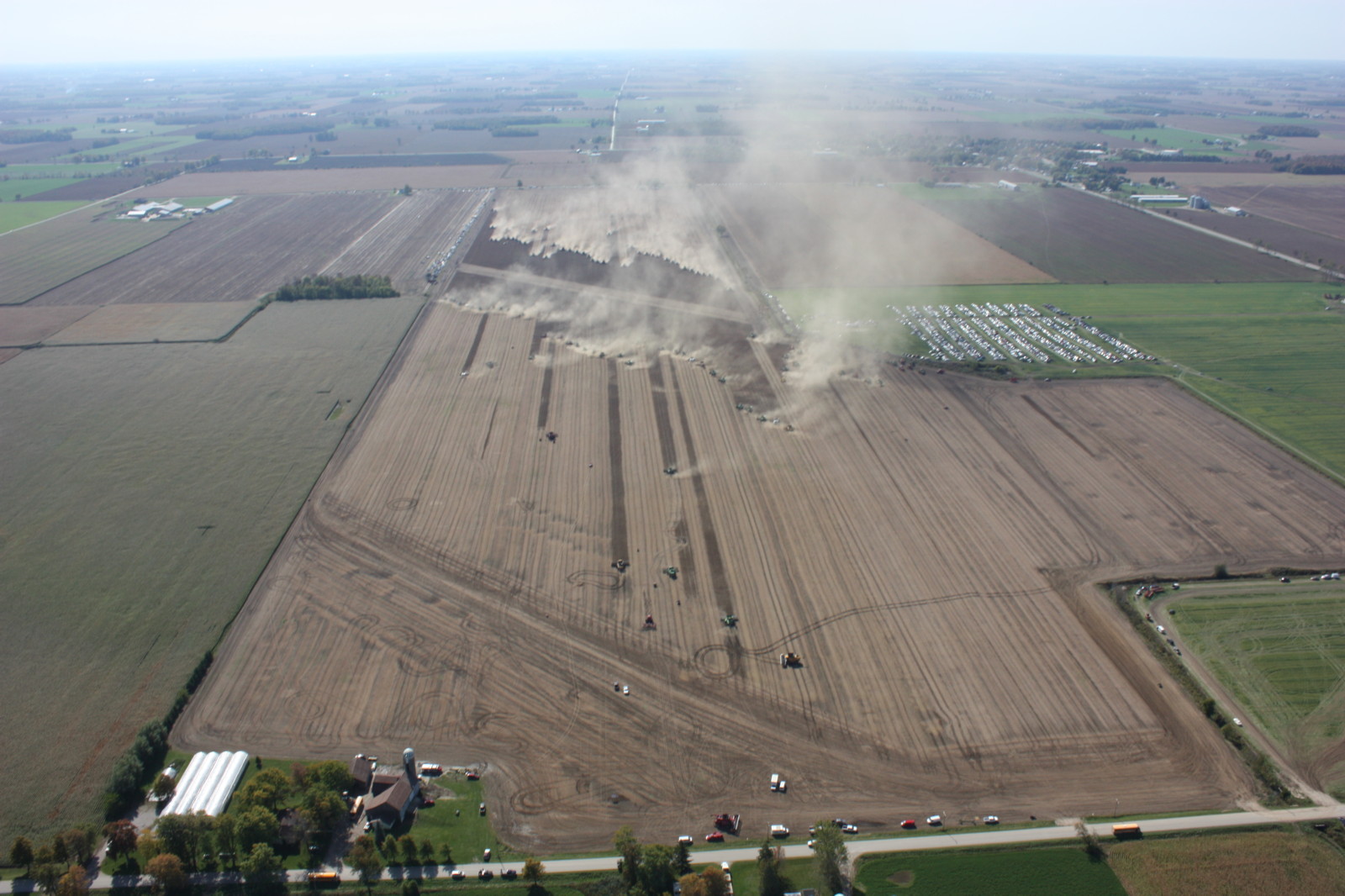
More than 100 farmers trying to set a world record for harvesting 160 acres of soybeans narrowly missed the mark Wednesday, gathering the crops in 11 minutes and 43.59 seconds.
Click here for video and story on the CTV website
The network for agriculture in Ontario, Canada
All We Need Is Good Weather For World Record Soybean Harvest.
Over 110 combines are committed to a Perth County farm for the world record soybean harvest attempt on September 30. A large crowd is expected to attend the site on Highway 23, 1 kilometre north of Monkton. Randy Drenth, chair of the group of farmers that is leading this attempt, emphasizes that their primary goal is raising awareness of the hunger issue.
“This event is primarily a fundraiser for the hunger relief projects the Canadian Foodgrains Bank,“ says Randy Drenth. “Everything is ready. All we need is good weather for the attempt to harvest 160 acres of soybeans in less than 10 minutes. This is our way of getting lots of attention for the auction that will follow the harvest. We want to raise $200,000.
The soybeans will be auctioned to the public in one bushel lots and in 400 or 500 bushel lots to the grain trade.
The public is invited for lunch. Beef and pork on a bun will be available for a donation to the Canadian Foodgrains Bank. Lunch will be served at noon. The Mitchell Legion Band will provide music.
All the combines are scheduled to be lined up in their assigned places by 12:45, when short welcome speech and greetings will start in the viewing area. The combines will bite into the standing soybeans at 1:30 p.m.
The event has attracted wide support from the agricultural community and its suppliers. Everything has been donated so that the full value of the auction can be donated to hunger relief.
The public can also be part of the fundraising by donating $20 per bushel to Harvest for Hunger. Donations can be made on the website of the Canadian Foodgrains Bank.
For more information visit the website http://harvest4hunger.wordpress.com/
Views: 1429
New Date Set for Record Soybean Harvest — Rain Soaked Soybeans Sunday Afternoon
A 10 minute world record harvest of 160 acres of soybeans will now be attempted on Wednesday, October 5.
The Harvest for Hunger Committee had no choice but move the date a second time after a weather system moved through Perth County on Sunday afternoon and again soaked the 160 acres of soybeans, one kilometre north of Monkton on highway 23.
“We will not have much of chance at a world record if one or two of the combines plug up because the soybean plants are damp,” noted Randy Drenth, the chair of the five-farmer group that has spearheaded this fundraiser for the Canadian Foodgrains Bank.
Dozens of enterprises and hundreds of community members are supporting the effort to set a record soybean harvest. Everyone is being stretched a bit more as a result of the rescheduling.
In spite of the weather setbacks H4H Committee continues to target $200,000 for famine relief.
“Rescheduling due to weather events is normal in the business of farming,” Elbert van Donkersgoed, a spokesperson for the organizers, told the media. “The rain has not dampened the commitment of these farm families to promote the Canadian Foodgrains Bank as an effective Christian response to hunger.”
The arrangements for the day will remain the same as originally planned for September 30. Lunch will be available for the public for a donation to the Canadian Foodgrains Bank at noon. Bleachers have been brought to the site so that a good view of the combines can be had by all.
Combine engines will be started at about 1:20 p.m. in preparation for the record attempt at 1:30 p.m. Shortly after the harvest, the soybeans will be auctioned to the highest bidder.
The public can support the fundraiser by ‘donating a bushel’ — $20 on the website of the Canadian Foodgrains Bank.
Canadian Foodgrains Bank is a partnership of Canadian Christian churches and church-based agencies working to end hunger in developing countries.
Background on the plans for the world record attempt can be found at Harvest for Hunger. This includes a site map.
- 30 -
For more information contact Elbert van Donkersgoed, 519-763-2589 or Harvest4Hunger@terracoeur.ca
Harvest for Hunger
World Record Soybean Harvest for Charity
October 5h, 2011
Perth Country, Ontario, Canada
160 acres and 120+ combines
*** Record: 11 minutes 43 seconds***
Donations for the Canadian Foodgrains Bank
Fabulous weather and turnout...had to be thousands of spectators....
Great job...congrats to the organizers.
Joe Dales
Harvest for Hunger just short of World Record on CTV news:
More than 100 farmers trying to set a world record for harvesting 160 acres of soybeans narrowly missed the mark Wednesday, gathering the crops in 11 minutes and 43.59 seconds.
Click here for video and story on the CTV website
© 2026 Created by Darren Marsland.
Powered by

