Ontario Agriculture

The network for agriculture in Ontario, Canada

World Record Soybean Harvest For Charity: Post Your Pictures, Videos, Thoughts Here.

All We Need Is Good Weather For World Record Soybean Harvest.

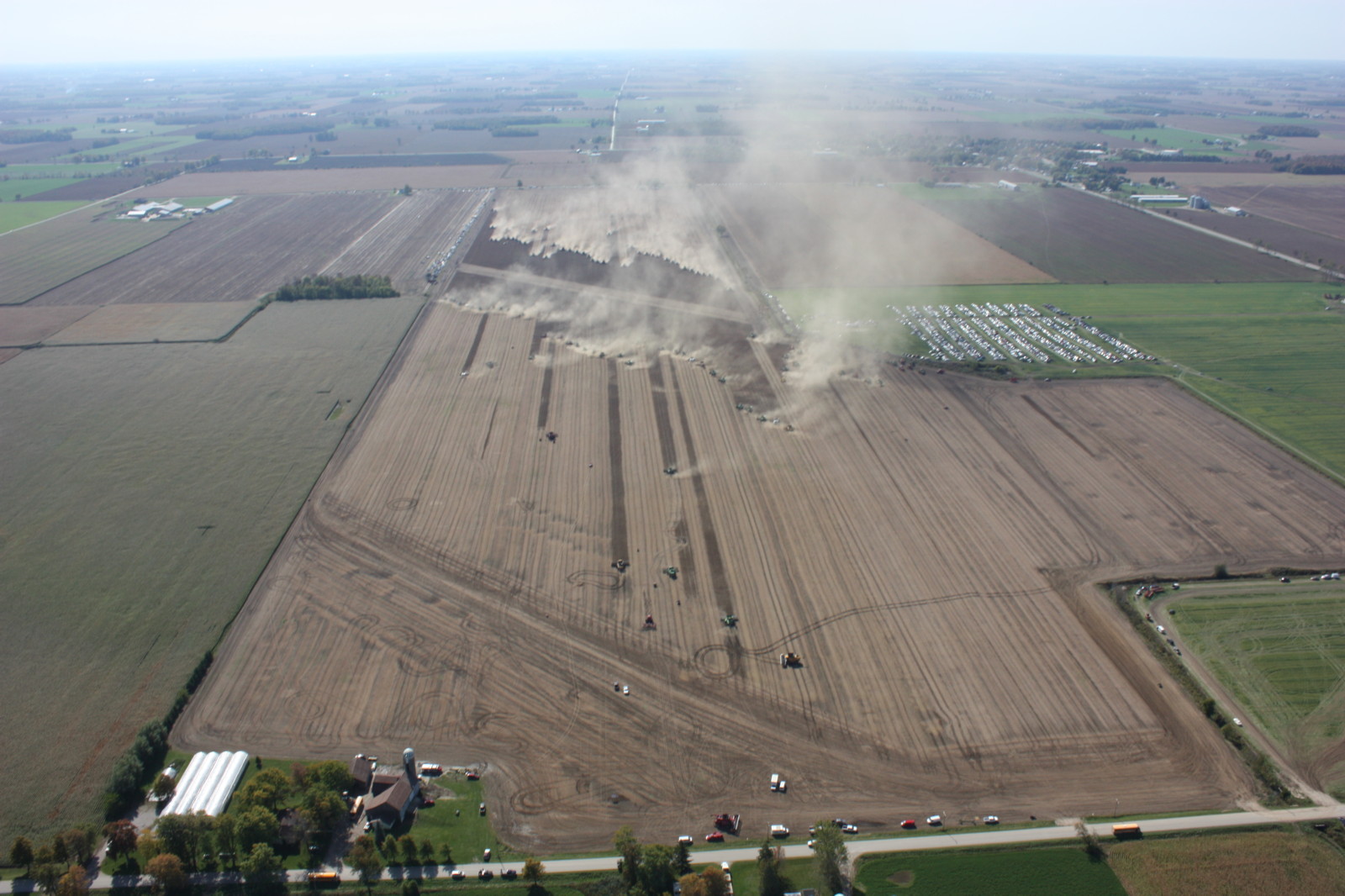
Over 110 combines are committed to a Perth County farm for the world record soybean harvest attempt on September 30. A large crowd is expected to attend the site on Highway 23, 1 kilometre north of Monkton.  Randy Drenth, chair of the group of farmers that is leading this attempt, emphasizes that their primary goal is raising awareness of the hunger issue.

“This event is primarily a fundraiser for the hunger relief projects the Canadian Foodgrains Bank,“ says Randy Drenth. “Everything is ready. All we need is good weather for the attempt to harvest 160 acres of soybeans in less than 10 minutes. This is our way of getting lots of attention for the auction that will follow the harvest. We want to raise $200,000.

 The soybeans will be auctioned to the public in one bushel lots and in 400 or 500 bushel lots to the grain trade.

The public is invited for lunch. Beef and pork on a bun will be available for a donation to the Canadian Foodgrains Bank. Lunch will be served at noon. The Mitchell Legion Band will provide music.

All the combines are scheduled to be lined up in their assigned places by 12:45, when short welcome speech and greetings will start in the viewing area. The combines will bite into the standing soybeans at 1:30 p.m.

The event has attracted wide support from the agricultural community and its suppliers. Everything has been donated so that the full value of the auction can be donated to hunger relief.

The public can also be part of the fundraising by donating $20 per bushel to Harvest for Hunger. Donations can be made on the website of the Canadian Foodgrains Bank.

For more information visit the website    http://harvest4hunger.wordpress.com/


Views: 1319

Reply to This

Replies to This Discussion


New Date Set for Record Soybean Harvest — Rain Soaked Soybeans Sunday Afternoon


A 10 minute world record harvest of 160 acres of soybeans will now be attempted on Wednesday, October 5.


The Harvest for Hunger Committee had no choice but move the date a second time after a weather system moved through Perth County on Sunday afternoon and again soaked the 160 acres of soybeans, one kilometre north of Monkton on highway 23.


“We will not have much of chance at a world record if one or two of the combines plug up because the soybean plants are damp,” noted Randy Drenth, the chair of the five-farmer group that has spearheaded this fundraiser for the Canadian Foodgrains Bank.


Dozens of enterprises and hundreds of community members are supporting the effort to set a record soybean harvest. Everyone is being stretched a bit more as a result of the rescheduling.


In spite of the weather setbacks H4H Committee continues to target $200,000 for famine relief.


“Rescheduling due to weather events is normal in the business of farming,” Elbert van Donkersgoed, a spokesperson for the organizers, told the media. “The rain has not dampened the commitment of these farm families to promote the Canadian Foodgrains Bank as an effective Christian response to hunger.”


The arrangements for the day will remain the same as originally planned for September 30. Lunch will be available for the public for a donation to the Canadian Foodgrains Bank at noon. Bleachers have been brought to the site so that a good view of the combines can be had by all.


Combine engines will be started at about 1:20 p.m. in preparation for the record attempt at 1:30 p.m. Shortly after the harvest, the soybeans will be auctioned to the highest bidder.


The public can support the fundraiser by ‘donating a bushel’ — $20 on the website of the Canadian Foodgrains Bank.


Canadian Foodgrains Bank is a partnership of Canadian Christian churches and church-based agencies working to end hunger in developing countries.


Background on the plans for the world record attempt can be found at Harvest for Hunger. This includes a site map.
 

- 30 -


For more information contact Elbert van Donkersgoed, 519-763-2589 or Harvest4Hunger@terracoeur.ca


Harvest for Hunger
World Record Soybean Harvest for Charity
October 5h, 2011
Perth Country, Ontario, Canada
160 acres and 120+ combines
*** Record: 11 minutes 43 seconds***

Donations for the Canadian Foodgrains Bank

Fabulous weather and turnout...had to be thousands of spectators....

Great job...congrats to the organizers.


Joe Dales

Harvest for Hunger just short of World Record on CTV news:


Farmers just miss soybean harvest world record

More than 100 farmers trying to set a world record for harvesting 160 acres of soybeans narrowly missed the mark Wednesday, gathering the crops in 11 minutes and 43.59 seconds.


Click here for video and story on the CTV website
Reply to Discussion

RSS

Agriculture Headlines from Farms.com Canada East News - click on title for full story

How University of Iowa dropouts built a global ag tech company

Matthew Rooda began working in the swine industry at a young age. First, he helped his grandfather on a family farm, and later he worked with his father, who managed a commercial farm in Iowa. When it was time for college, he enrolled at the University of Iowa with plans to study genetics and biotechnology, and eventually planned to go to medical school to become an obstetrician. When Rooda met with the medical school admissions committee at the University of Iowa, he was told that he had to be different to stand out. He thought back to the experiences he had working on farms. Rooda told the committee he had experience with vaccinations, birthing assistance and management on farms. “They said, ‘That's exactly what we're looking for,’” he said. His junior and senior years of college, Rooda worked at nursing homes and he noticed more connections between farming and health care. He saw how nursing homes used technology and management practices to weed out inefficiencies in their car

MU Extension tackles persistent labor shortages in hog production

University of Missouri Extension specialists are working with the swine industry and temporary visa holders to help recruit, retain and develop agriculture professionals needed to address ongoing farm labor shortages. The TN visa program was established in 1994 under the North American Free Trade Agreement. The “TN” designation, short for Treaty NAFTA, refers to a professional nonimmigrant classification now governed by the United States-Mexico-Canada Agreement. TN visas allow U.S. employers to hire specialized agriculture professionals from Mexico and Canada. Unlike programs such as H-2A, which focus on seasonal farm labor, the TN visa program supports year-round professional positions. That’s an important advantage for swine operations that require consistent staffing, says Magdiel Lopez, a livestock specialist with University of Missouri Extension who leads the project funded through checkoff dollars from the National Pork Board. TN visa holders typically meet specific educationa

Swine fever deaths surge in Spain amid fears of new virus strain

Spain has recorded a surge in the deadly African swine fever sweeping Catalonia as authorities bring in drones and helicopters to help contain the outbreak. The region’s department of agriculture announced on Monday that a further 18 wild boar have died from the highly contagious disease near Cerdanyola del Valles, bringing the tally up to a total of 47. The ministry said that the rise was due to wider testing in hard-to-reach areas, explored by air over the Christmas holidays. It emphasised that it was an “accumulation” of cases reported, and not a “sudden” spike. Spain ramped up containment efforts in December, bringing in sniffer dogs and the military to help track the spread. More than 620 boars have been analysed in recent weeks, with around eight per cent testing positive for the virus. Researchers believe the ‘Bellaterra’ variant could be a new mutation, after it failed to match with any samples held locally. The local government has downplayed the theory that it could have

Swine Innovation Porc unveils 4 Advancing Swine Research projects

Swine Innovation Porc is pleased to announce four research projects under its Advancing Swine Research Call for Proposals, a national initiative designed to strengthen the resiliency, sustainability and competitiveness of Canada’s pork sector. Supported by the Pork Promotion and Research Agency, the projects announced represent the first set of approved investments under a highly competitive, industry-guided research call. Additional approved projects will be announced as partner co-funding decisions are finalized. For the four projects announced, SIP will invest up to $488,347, mobilizing up to $1.18 million in total project funding to advance innovation across priority areas including housing systems, animal health, energy efficiency and product quality. “SIP is proud to lead this national research effort that channels research investments into meaningful, targeted impact for producers and processors,” said Mark Ferguson, chair of SIP. “This call delivered exceptional proposals fr

Pork producers address USDA's New World screwworm response

The National Pork Producers Council submitted comments on the USDA's draft response plan for a New orWld screwworm detection in the United States. NPPC's feedback addressed areas of the response including movement controls and movements to slaughter, treatment and physical examinations, among others. NWS is a flesh-eating parasite from female flies that lay eggs in wounds on warm-blooded animals, including pigs and people. According to USDA, animals that recently have given birth, suffered an injury, or had a surgical procedure such as tail docking or branding are most vulnerable. Even tick bites can attract NWS flies. The disease has moved from South America through Central America and into Mexico over the past few years, with a case recently being identified in cattle a few hundred miles south of the U.S.-Mexico border. It is endemic in Cuba, the Dominican Republic, Haiti and some South American countries. In May, USDA closed the U.S. southern border to imports of cattle from Mexi

© 2026   Created by Darren Marsland.   Powered by

Badges  |  Report an Issue  |  Terms of Service