Ontario Agriculture

The network for agriculture in Ontario, Canada

Robert Campbell
  • Toronto, Ontario
  • Canada
Share on Facebook MySpace

Robert Campbell's Discussions

Photos from 2017 Northumberland Beef Farmers BBQ in Dartford, Ont, 06 July
1 Reply

Hey readers and beef farming enthusiasts, here are photos from annual Northumberland Beef Farmers BBQ which was held this year on Ryan Campbell's farm in Dartford, Ontario - 06 July 2017…Continue

Tags: event, farm, equipment, photos, annual

Started this discussion. Last reply by Chris RAlph May 29, 2018.

WANTED: pictures of barns missing boards for a story on thieves

I need pictures of old barns missing boards  and stories about cedar fence rail thieves and barn board thieves - do they ever get caught?Have you personally lost fence rails? barn boards?  or caught…Continue

Tags: Ontario, architectural, wood, Toronto, restaurant

Started Jun 15, 2015


Robert Campbell's Page

Profile Information

How are you involved in agriculture?
Farm Livestock, Agri-Business

Canadian Beekeeper in Ontario
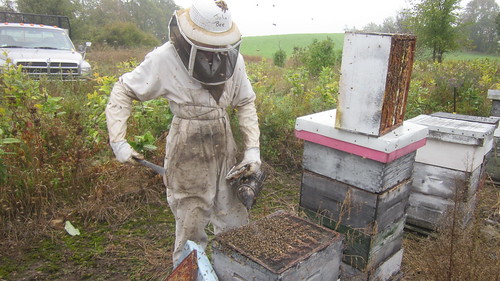
Here's Johnny Bee Good in a beeyard near Hastings Ontario in August 2011 making ready with his hive tool to remove the queen excluder, which is a metal screen that restricts the queen to the brood chambers below. This keeps eggs out of the honey supers above - you can see the super has been removed and now sits upright beside Johnny. I wrote about the 2011 honey harvest was near crop failure, on Son of a Beekeeper , my Tumblr blog.

Robert Campbell's Photos

  • Add Photos
  • View All

Robert Campbell's Blog

Ontario Beekeepers Prize Pungent Buckwheat Honey

After spending time with another local beekeeper and helping harvest his annual summer honey crop this son of a beekeeper has become even more acutely aware of the various honey regions that are waiting to be discovered by North American kitchens , across the province of Ontario.

One such naturally occurring region is the wild buckwheat fields in northeastern Ontario, above hwy 7 on…

Continue

Posted on September 1, 2012 at 3:00pm — 1 Comment

New Holland 658, Baling Hay in Ontario Canada

Talk about 'making hay while the sun shines'. Here's a short video I shot on Saturday June 16th 2012 of my nephew Ryan baling hay with his New Holland 658 hay baler. The grass feed is a mixture of alfalfa, red clover and timothy and as such will make excellent feed for the growing numbers of cows on their feedlots.

I can remember harvesting the hay in this field in the 1970s and 80s - we used to walk behind the tractor and wagon and pitch 80 lbs bales onto the wagon…

Continue

Posted on June 17, 2012 at 2:36am

Black Bears Strike But Are Repelled By Electric Fences In Ontario Beeyards

Some black bears did launch an attack on of our remote beeyards last week! 

This is what bear damage looks like, and it could have been a lot worse. The total loss was only four frames of brood. And that's because this beeyard, like all of our locations in southern Ontario, is protected by a heavy duty solar fencer.
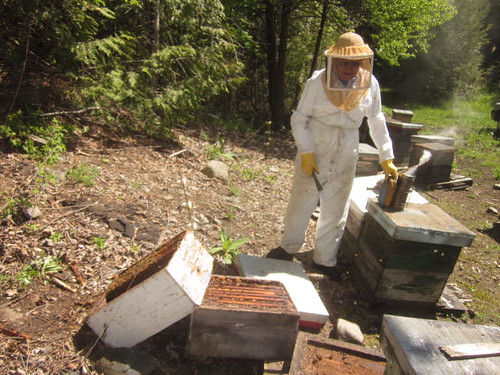
bear damage in beeyard

Its unlikely the hive blew over in the wind - in the…

Continue

Posted on May 13, 2012 at 1:49pm — 1 Comment

Son of a Beekeeper Blog on Ontario Agriculture Network
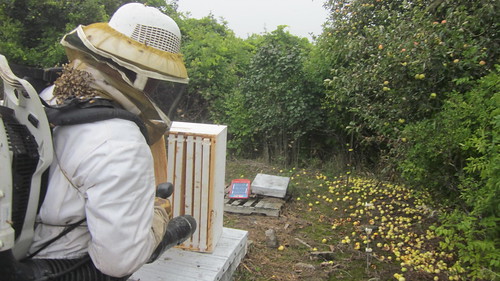
Hello from Rob Campbell the original Son of a Beekeeper in Ontario Canada.


I hope to keep a blog presence here on the Ontario Agricultural network to keep readers updated on the latest challenges facing Canadian beekeepers. Because I have the good fortune of living near and helping out my family's…

Continue

Posted on April 15, 2012 at 4:50am — 1 Comment

Comment Wall

You need to be a member of Ontario Agriculture to add comments!

Join Ontario Agriculture

  • No comments yet!


Agriculture Headlines from Farms.com Canada East News - click on title for full story

I’m switching my wheat variety; do I need to change my seeding rate?

The short answer is yes; you will most likely need to change your seeding rate, but this is not just because you are planting a different wheat variety. Rather, seeding rates should be adjusted annually to reflect seed source characteristics (germination, thousand kernel weight [TKW]) and the environment the seed is being planted into, to ensure you can achieve your target plant population.   Let’s dig into why this is. For spring wheat, provincial target plant population recommendations are between 23-28 pl/ft2, with many producers targeting the upper end of this recommendation. Achieving your target plant stands sets your crops up for success, as crop uniformity is improved, weed pressure is combatted and resources are optimized.  Seeding rates should be calculated to achieve your target plant stand, which means accounting for germination percentage, expected mortality and, importantly, your TKW. TKW changes year-to-year and from variety to variety. Let’s consider an example to ill

How much 10-34-0 can be applied with my corn seed?

Oddly, I have had this conversation more this winter/spring than ever before. On paper, there is a finite answer. Anecdotally, there are a few different options and it is all dependent on soil type and soil conditions, moisture, etc. First of all, side-banding any type of fertilizer is much safer than placing it with the seed. Some fertilizers are safe in certain quantities with the seed, but very few. Side-banding is much safer and provides quick access to the roots. Midrow banding is the safest method, but roots take that much longer to access the fertilizer row, which negates the “starter” effect. The other factor that indicates the level of safety is soil moisture; the drier the soil, the more risky it is to place any fertilizer with or near the seed. I’m guilty of thinking that fertilizer toxicity to the seed is mainly due to the nitrogen content and a result of ammonia burn. Salt injury is actually more common and affects germination and early season growth, so applying fertili

AGT Food and Ingredients Inc. Announces Date for Q1 2026 Results and Conference Call

AGT Food and Ingredients Inc. (TSX: AGTF) ("AGT" or the "Company") announces the release of its Q1 2026 results on May 12, 2026 after market close and has scheduled a conference call at 8:30 a.m. Eastern time on May 13, 2026. To join the conference, please dial 1-833-821-0163 (toll free from Canada & the U.S.) or +1-647-846-7232 (from outside Canada & the U.S.). An audio replay of the conference call will be available on AGT's website after the call by visiting www.agtfoods.com. The financial statements and notes thereto for the three months ended March 31, 2026, as well as the related management's discussion and analysis will be filed on SEDAR+ at www.sedarplus.com and will also be available on the AGT website at www.agtfoods.com prior to the conference call. About AGT AGT is a globally diversified food company that produces high-quality, nutritious products for everyday consumption. Our products reach consumers in 127 countries, and our global footprint consists of 39 state-of-the

Rising Waters on the Canadian Prairies and Beyond

With flooding affecting several Canadian provinces, farmers are being urged to act quickly to protect crops, animals, infrastructure, and long-term soil health.

Is Your Bull Ready? A Year-Round Approach to Bull Management

Every cow-calf producer has either lived it or knows someone who has. Breeding season wraps up and everything looks fine, until fall preg-checks tell a different story: open cows, late calvers and a breeding window that slipped wider than planned. While cow nutrition, body condition and management are frequently evaluated, one critical factor is often underestimated—the bull. Most frustrating is that there are often no obvious warning signs during breeding. The bull was turned out, was covering cows and looked the part. On the surface, everything appeared normal. That’s exactly why a bull breeding soundness evaluation (BBSE) matters more than many producers realize. It is one of the few opportunities to take some guesswork out of bull performance. On a cow-calf operation, bulls get a lot of attention for a couple of months out of the year and very little once breeding season wraps up. The reality is that a bull’s value doesn’t start on turnout day, and it definitely doesn’t end when

© 2026   Created by Darren Marsland.   Powered by

Badges  |  Report an Issue  |  Terms of Service