Ontario Agriculture

The network for agriculture in Ontario, Canada

Robert Campbell
  • Toronto, Ontario
  • Canada
Share on Facebook MySpace

Robert Campbell's Discussions

Photos from 2017 Northumberland Beef Farmers BBQ in Dartford, Ont, 06 July
1 Reply

Hey readers and beef farming enthusiasts, here are photos from annual Northumberland Beef Farmers BBQ which was held this year on Ryan Campbell's farm in Dartford, Ontario - 06 July 2017…Continue

Tags: event, farm, equipment, photos, annual

Started this discussion. Last reply by Chris RAlph May 29, 2018.

WANTED: pictures of barns missing boards for a story on thieves

I need pictures of old barns missing boards  and stories about cedar fence rail thieves and barn board thieves - do they ever get caught?Have you personally lost fence rails? barn boards?  or caught…Continue

Tags: Ontario, architectural, wood, Toronto, restaurant

Started Jun 15, 2015


Robert Campbell's Page

Profile Information

How are you involved in agriculture?
Farm Livestock, Agri-Business

Canadian Beekeeper in Ontario
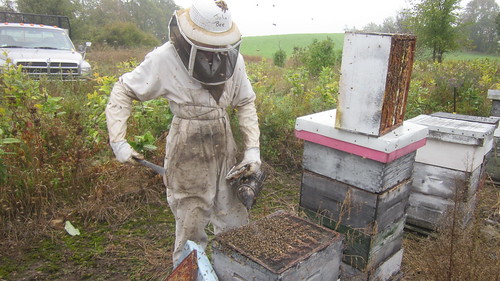
Here's Johnny Bee Good in a beeyard near Hastings Ontario in August 2011 making ready with his hive tool to remove the queen excluder, which is a metal screen that restricts the queen to the brood chambers below. This keeps eggs out of the honey supers above - you can see the super has been removed and now sits upright beside Johnny. I wrote about the 2011 honey harvest was near crop failure, on Son of a Beekeeper , my Tumblr blog.

Robert Campbell's Photos

  • Add Photos
  • View All

Robert Campbell's Blog

Ontario Beekeepers Prize Pungent Buckwheat Honey

After spending time with another local beekeeper and helping harvest his annual summer honey crop this son of a beekeeper has become even more acutely aware of the various honey regions that are waiting to be discovered by North American kitchens , across the province of Ontario.

One such naturally occurring region is the wild buckwheat fields in northeastern Ontario, above hwy 7 on…

Continue

Posted on September 1, 2012 at 3:00pm — 1 Comment

New Holland 658, Baling Hay in Ontario Canada

Talk about 'making hay while the sun shines'. Here's a short video I shot on Saturday June 16th 2012 of my nephew Ryan baling hay with his New Holland 658 hay baler. The grass feed is a mixture of alfalfa, red clover and timothy and as such will make excellent feed for the growing numbers of cows on their feedlots.

I can remember harvesting the hay in this field in the 1970s and 80s - we used to walk behind the tractor and wagon and pitch 80 lbs bales onto the wagon…

Continue

Posted on June 17, 2012 at 2:36am

Black Bears Strike But Are Repelled By Electric Fences In Ontario Beeyards

Some black bears did launch an attack on of our remote beeyards last week! 

This is what bear damage looks like, and it could have been a lot worse. The total loss was only four frames of brood. And that's because this beeyard, like all of our locations in southern Ontario, is protected by a heavy duty solar fencer.
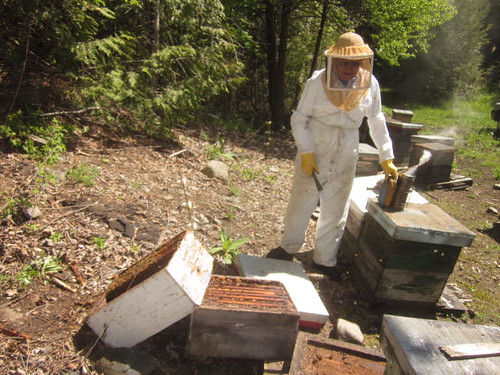
bear damage in beeyard

Its unlikely the hive blew over in the wind - in the…

Continue

Posted on May 13, 2012 at 1:49pm — 1 Comment

Son of a Beekeeper Blog on Ontario Agriculture Network
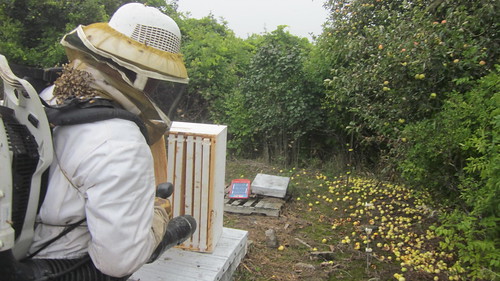
Hello from Rob Campbell the original Son of a Beekeeper in Ontario Canada.


I hope to keep a blog presence here on the Ontario Agricultural network to keep readers updated on the latest challenges facing Canadian beekeepers. Because I have the good fortune of living near and helping out my family's…

Continue

Posted on April 15, 2012 at 4:50am — 1 Comment

Comment Wall

You need to be a member of Ontario Agriculture to add comments!

Join Ontario Agriculture

  • No comments yet!


Agriculture Headlines from Farms.com Canada East News - click on title for full story

Hursh: My canola acreage prediction

Statistics Canada will release a seeded area estimate on June 30. This will be based on data collected in late May and early June. I'm predicting a larger than expected increase in canola acreage. In its preliminary seeding intentions report back in March, Statistics Canada predicted a 1.0 per cent increase in Canadian canola area to 21.8 million acres. A lot has happened since then and canola prices have seen more strength than other commodities. Canola also looks good from a crop insurance coverage point of view even in non-traditional canola growing regions. Canola is already a large percentage of the cropland in central and northern areas of the grain belt limiting how much more it can increase. However, I believe acreage may have increased dramatically in many southern regions. In southwest Saskatchewan where I farm, I can’t remember seeing so many canola fields. Canola here still isn’t nearly as common as lentils or durum, but there’s a surprising amount of canola and mos

Seeding virtually done in Saskatchewan, though some acres unseeded

The latest provincial crop report indicates seeding is basically done in Saskatchewan as progress is marked at 99 per cent complete. A map of seeding progress province-wide shows an area from Hudson Bay down to Yorkton is between 85 and 95 per cent complete, with pockets at less than 80 per cent complete. The east-central region as a whole is at 96 per cent complete while other regions are at 99 or 100 per cent. However, three per cent of acres of the province went unseeded due to excessive moisture. "Similarly, three per cent of forage crops have excess moisture and are unlikely to produce a crop while two per cent of pastureland is not accessible or is unusable," states the report. "In areas experiencing reduced moisture, two per cent of the seeded acreage this spring in the province is affected. Five per cent of the forage crops may have yields significantly impacted, while five per cent of pastures may have reduced carrying capacity." Rainfall this past week delayed fieldwork,

Cereals Canada Releases its 2025 Annual Report

Cereals Canada has released its 2025 Annual Report, highlighting a year of strong market development, technical leadership, and advocacy efforts that reinforced Canada’s position as a leading global supplier of high-quality wheat, durum, oats, and barley. Throughout 2025, Cereals Canada continued to support international customers and strengthen demand for Canadian cereals through targeted market development programming, technical expertise, and proactive market access engagement. Canada exported cereals to more than 80 countries, with cereal exports valued at approximately $12.8 billion annually, demonstrating continued global confidence in Canadian quality and reliability. A key priority throughout the year remained helping global customers understand and optimize the value of Canadian cereals. Through technical support, customer outreach, and crop quality programming, Cereals Canada worked closely with global buyers to ensure Canadian quality translated into measurable value throu

Cereals Canada Announces New Board Leadership

Adam Dyck, industry representative from Warburtons, has been elected Chair of the Cereals Canada Board of Directors. As Chair, Dyck will help lead the organization’s work to strengthen Canada’s position as a trusted supplier of high-quality wheat, durum, barley, and oats. Rounding out the executive committee is Josh Boersen, producer representative from Grain Farmers of Ontario, as Vice-Chair; Rob Stone, producer representative from Saskatchewan Wheat Development Commission, as Secretary; and Jean-Marc Ruest, industry representative from Richardson International, as Treasurer. The Board also welcomed four newly elected directors, whose insight and leadership will guide the organization’s efforts to support market development, customer engagement, and innovation across the cereals sector. “The Board of Directors plays a critical role in guiding our work on behalf of Canada’s cereals value chain,” said Dean Dias, chief executive officer of Cereals Canada. “We are pleased to welcome Ad

Knowledge Centre receives $2.6 million from Weston Family Prairie Grasslands Initiative

Stretching across Saskatchewan, Alberta, and Manitoba, Canada’s prairie grasslands support hundreds of species, including migratory birds, pollinators and people, while also sustaining soil health, water systems, livestock production, and Indigenous stewardship. Yet of the roughly 141 million acres of historical grasslands in Canada, only 26 million acres remain intact today. What remains of prairie grasslands represents a rare and urgent opportunity to protect biodiversity at scale. “Indigenous lifeways, languages, and food systems evolved with the environment, and these reciprocal relationships shaped the ecological processes that can restore the health of grasslands,” said Candice Pete-Cardoso, director of the kihci-okawimaw askiy Knowledge Centre at USask. The new Indigenous Grasslands Stewardship and Knowledge Exchange Network has been launched by the kihci-okawimaw askiy Knowledge Centre together with the Indigenous Kinship Circle (IKC). The IKC is a cross-boundary community of

© 2026   Created by Darren Marsland.   Powered by

Badges  |  Report an Issue  |  Terms of Service