Ontario Agriculture

The network for agriculture in Ontario, Canada

OntAG Admin's Blog (277)

TED TALK by Chris Hadfield, Astronaut, Cmdr Hadfield is the Keynote Speaker at the 2014 March Classic, March 24th in London, Ontario


2014 March Classic - Grain Farmers of Ontario Event - will be held on Monday March 24th at the London Convention Centre.…

Continue

Added by OntAG Admin on March 19, 2014 at 8:30am — 2 Comments

University of Guelph President Alastair Summerlee on Misinformation Circulating on Enrollment for Agriculture Campuses

Summerlee: Correcting Tweets and Misinformation

I have noticed that there is misinformation circulating in social media and elsewhere with respect to application figures to our campuses at Ridgetown, Kemptville and Alfred. I think it important to set the record straight. Fall 2014 application figures for the associate diploma program on the three campuses are as follows:

Ridgetown - 1117 

Kemptville -…

Continue

Added by OntAG Admin on March 19, 2014 at 5:45am — No Comments

Stats Can: Corn for grain: the world’s top cereal crop

Stats Can: Corn: Canada's third most valuable crop…

Continue

Added by OntAG Admin on March 19, 2014 at 5:00am — No Comments

Farms.com Market School: How Grain Prices Are Determined. Click to Watch.


For additional videos visit

http://www.marketschool.farms.com

Added by OntAG Admin on March 16, 2014 at 1:40pm — No Comments

University of Guelph President Alastair Summerlee on the closure of the University’s Kemptville and Alfred campuses

Summerlee: Facts, Not Conjecture, Needed in Times Like These

Earlier today, I took part in a live radio discussion with North Grenville Mayor David Gordon about the closure of the University’s Kemptville and Alfred campuses. This followed yesterday’s announcement that the University is consolidating the academic and research programs delivered at these two campuses to improve efficiency and ensure quality.

I was touched by David’s commitment,…

Continue

Added by OntAG Admin on March 13, 2014 at 7:30am — No Comments

Canada Space-Based Crop Map Coast to Coast - And Interactive Map to "Play with the Data"


Thanks to our friends at Agriculture and Agri-Food Canada there is an interactive map where you can zoom in on the crop map data: CLICK HERE…

Continue

Added by OntAG Admin on March 12, 2014 at 7:30am — 2 Comments

Corn Share Program Teaches Young Farmers To Grow Their Own Crop.

Young farmers walking their fields with DuPont Pioneer this season

Fifteen to 18-year-old farmers have the opportunity to plant their own corn crop with the 2014 DuPont Pioneer Corn Share for the third year running. Corn Share started as a pilot program in 2012, with 18 participants in Perth and Huron counties. Last year, it grew to include 123 young farmers from across the province. Pioneer expects even higher numbers this…

Continue

Added by OntAG Admin on March 11, 2014 at 5:16am — No Comments

Innovative Farmer of the Year Winner: Tom Barrie

Creativity and advancements in crop rotation systems in their no-till farming operation have earned Tom Barrie, a Bowmanville grower, and his team, the 2013 Innovative Farmer of the Year Award. Each year, BASF Canada and the Innovative Farmers Association of Ontario recognize an…

Continue

Added by OntAG Admin on March 1, 2014 at 8:00am — 1 Comment

Infographic: Growth of Technology

North American Study on Technology in Agriculture from Dupont Pioneer

Added by OntAG Admin on February 25, 2014 at 3:30am — No Comments

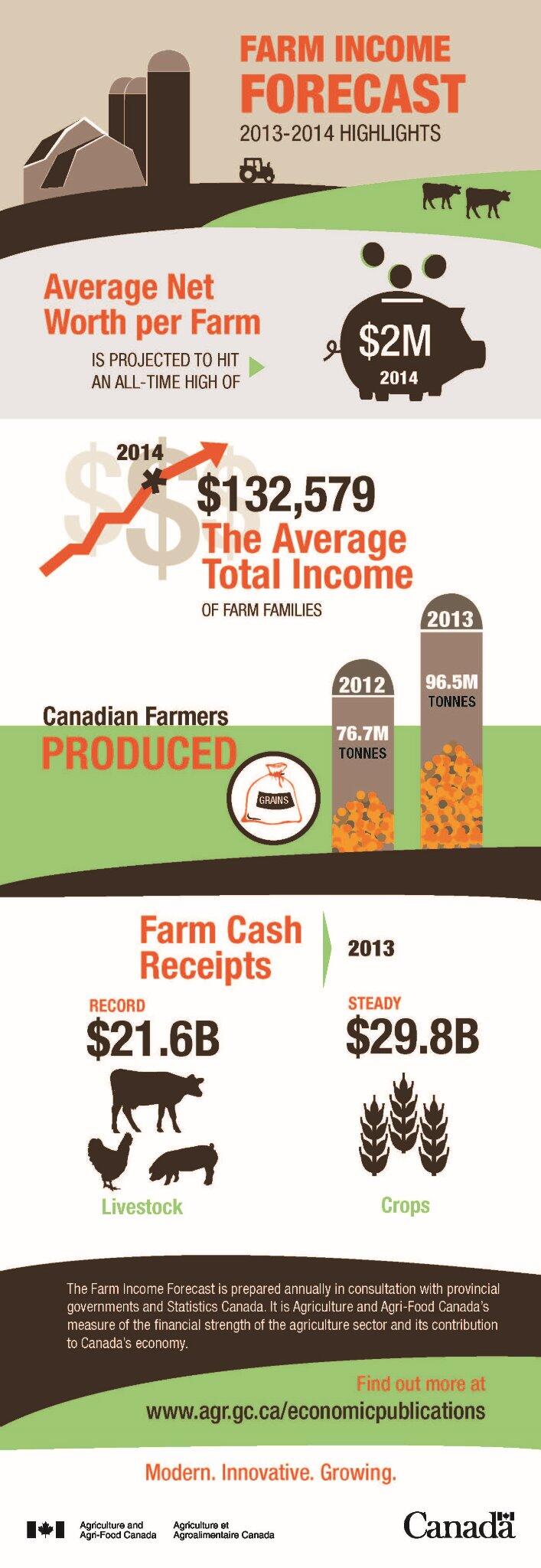
Infographic: Canadian Farm Income Forecast Highlights 2013-2014

Added by OntAG Admin on February 19, 2014 at 12:30pm — No Comments

Trish Jordan Blog: Sochi 2014 – A Day Off in Russia

By Trish Jordan, Public & Industry Affairs Director, Monsanto Canada

After a busy last couple of days in my 2014 Olympic Winter Games experience in Sochi, Russia, I was finally able to sleep in on Friday morning as the women’s Canadian curling team had a bye. Happy belated Valentine’s Day everyone!

It was great not to have to be down in the lobby of our hotel at our usual 7:30 am departure time. With…

Continue

Added by OntAG Admin on February 16, 2014 at 10:12am — 1 Comment

Trish Jordan Blog: Sochi 2014 – Canada Olympic House Lows and Highs

By Trish Jordan, Public & Industry Affairs Director, Monsanto Canada…

Canada House at Sochi

Continue

Added by OntAG Admin on February 15, 2014 at 3:30am — 1 Comment

Trish Jordan (Monsanto Canada) Blog: Sochi 2014 – The Adventure Continues

By Trish Jordan, Public & Industry Affairs Director, Monsanto Canada…

Carol Jones, mother of Team skip Jennifer Jones, farmer and rancher Jesse Lawrence, and Trish

Continue

Added by OntAG Admin on February 12, 2014 at 9:30am — 1 Comment

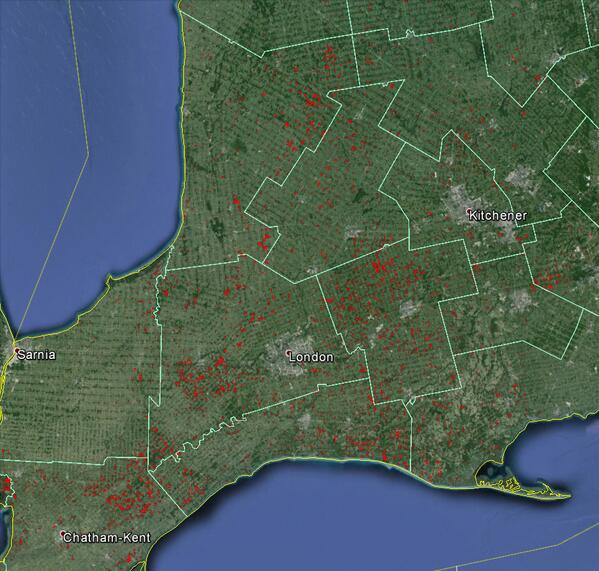
3-yr rotations. S. Ont. producers who grew corn '11, soybean '12, & wheat '13 (from AAFC crop map

Another Agriculture and Agrifood satellite map thanks to Leander Campbell.

3-yr rotations. S. Ont. producers who grew corn '11, soybean '12, & wheat '13 (from AAFC crop maps) Embedded image permalink

Added by OntAG Admin on February 11, 2014 at 10:00am — No Comments

Who loves corn? These producers probably do! S. Ont. fields that grew corn in '11, '12 & '13

Another Agriculture and Agrifood satellite map thanks to Leander Campbell.


Who loves corn? These producers probably do! S. Ont. fields that grew corn in '11, '12 & '13. (AAFC crop maps) …

Continue

Added by OntAG Admin on February 11, 2014 at 9:12am — No Comments

Trish Jordan (Monsanto Canada) Blog: Sochi 2014 – Full of Surprises on Day One

By Trish Jordan, Public & Industry Affairs Director, Monsanto Canada…

The Black Sea near the Canadian group hotel

Continue

Added by OntAG Admin on February 10, 2014 at 2:30pm — 2 Comments

FCC Video: Meet Hayley Wickenheiser, A Champion On And Off The Ice.

Added by OntAG Admin on February 7, 2014 at 1:30pm — No Comments

Monthly Archives

2019

2018

2017

2016

2015

2014

2013

2012

2011

2010

2009

Agriculture Headlines from Farms.com Canada East News - click on title for full story

Guinness World Record attempt to take place in St. Albert on Aug. 22

?ST. ALBERT – If you have ever wanted to witness an attempt at a Guinness World Record, then you will want to be in St. Albert, Ontario on August 22 when an attempt will be made to set a record for the most plow blades pulled simultaneously.

Why Alignment Matters: Domestic Check-Off and the Import Levy

When Canadian beef producers sell cattle, they contribute to the national beef check-off. That investment supports work that benefits the broader Canadian beef industry, including market development, consumer demand, public and stakeholder engagement, and research. When beef or beef cattle are imported into Canada, an import levy is also collected. While the structure is not identical in every detail, the principle behind it is straightforward: beef marketed in Canada should help contribute to the programs that support beef demand in Canada. The national check-off paid by producers and the import levy paid on eligible imports are two parts of a broader investment approach. Together, they help ensure that both domestic beef production and imported beef products are connected to the market development work that strengthens beef’s position with Canadian consumers. For producers, the domestic cattle check-off is collected at the point of sale and includes both national and provincial po

I’ve noticed a lot of wild oat escapes in some of my fields this year; what can I do to prevent it from getting worse next year?

Despite our best efforts, sometimes even the best laid weed control plans go wrong! The first thing to remember is that not all weed escapes are created equal. In some cases, weeds can survive because of application timing issues, challenging weather conditions or late flushes that emerge after spraying. However, when weeds aren’t controlled by herbicide applications, herbicide resistance should also be on your radar. A recent survey in Manitoba found that in fields with uncontrolled wild oats, 100 per cent of populations were resistant to Group 1 products, 82 per cent were resistant to Group 2 products, and 82 per cent were resistant to both Group 1 and 2 herbicides. Those numbers show how important it is to take a closer look at wild oat weed escapes. Identifying why your herbicide failed to control wild oats is the first step toward finding a solution. Start by scouting the field to narrow down the cause. Consider factors such as application timing, weather conditions, late flush

Is fungicide actually effective on Sclerotinia head rot in sunflower?

This is one of the most difficult questions to answer because there are many things to consider. I also don’t want to be outright negative because we do still have options for sclerotinia management in sunflowers. However, management is the operative word. First of all, sclerotinia head rot infections have an interesting pathway. Spores use dead sunflower florets, plus pollen, as the base to infect a sunflower plant. The spores grow into the receptacle, infecting and decaying the entire head after a period of time. Sclerotinia wilt (basal stalk rot) and mid-stalk rot are also infected by the same sclerotinia species, but it will be via the mycelia that grow from the sclerotia bodies in the soil for basal stalk rot. Mid-stalk rot is also infected by ascospores, but this can be earlier in the season than head rot or at the same time. So, management of sclerotinia does not start at flowering. Crop rotation is the most obvious management tool that we are familiar with in sunflowers, but

Using Water More Efficiently in Beef Packing Plants

Packing plants use a time-tested approach to clean their facilities. The first step uses high-pressure hot water to remove fat and meat scraps from equipment, floors and walls. Next, surfaces are cleaned using detergent. Finally, sanitizers are used to further reduce bacterial numbers. Processing companies want to reduce water use as part of their environmental goals and to reduce energy bills. High-pressure water and steam can produce aerosols that capture bacteria and spread them throughout the plant. They can then settle on and cross-contaminate clean surfaces long after the cleaning has been completed, which complicates efforts to effectively clean facilities. Biofilms are another problem. Biofilms are colonies of bacteria surrounded by a protective layer that firmly attaches them to surfaces and shelters the bacteria from hot water, detergents and sanitizers. Biofilms are hard to remove and are commonly found in hard-to-reach places. These researchers investigated potential cro

© 2026   Created by Darren Marsland.   Powered by

Badges  |  Report an Issue  |  Terms of Service